Shopify Landing Page Templates: Choose the Right One in 2026
September 4, 2026·10 min read·by Faisal Hourani·
You're on the list! We'll be in touch soon.
Join the waitlist
Get early access to AI-powered ad creative testing.
What Is a Shopify Landing Page Template?
Templates save time. They rarely save conversions.
A Shopify landing page template is a pre-built page layout — sold through the Shopify App Store or built into a theme's Online Store 2.0 sections — that a merchant customizes with their own copy, images, and offer instead of designing a page from scratch. The average Shopify store converts visitors at just 1.4%, and the best 10% convert above 4.7% (Littledata benchmark data). A template only closes that gap if its section order matches how your specific traffic actually decides to buy.
Desk setup with a laptop, used to plan and build a Shopify landing page template
Every template promises the same thing: hero section, social proof, features, testimonials, CTA. That structure works for a generic product. It rarely matches a specific offer, a specific objection, or a specific traffic source. A template built for a $30 impulse buy and a template built for a $300 considered purchase should not look the same, but most template libraries sell you the same skeleton for both.
That's the real cost of a template. Not the price tag, the section order. Get the order wrong and the page loads fast, looks professional, and still underperforms.
Why Do Most Shopify Landing Page Templates Fail to Convert?
Most templates are built to look good in a screenshot, not to move a specific visitor toward a specific action.
Shopify landing page templates fail to convert primarily because they're built for demos, not for your traffic source. A template optimized for organic search visitors (who arrive with context) performs poorly for cold Meta traffic (who need the context built into the page). According to Unbounce's 2024 Conversion Benchmark Report, mobile traffic drives nearly 5x more visitors than desktop, yet desktop converts 8% higher — a gap most templates never account for.
Three specific failure points show up over and over:
Wrong section order for the awareness level. A template puts pricing above the fold for cold traffic that has never heard of your brand. Cold visitors need the problem stated before the offer.
No mobile-specific hierarchy. The desktop layout gets squeezed into a mobile viewport instead of redesigned for it. Given that most paid traffic arrives on mobile, this alone caps your ceiling.
Generic copy blocks. Placeholder headlines like "Transform Your Business" get swapped for a slightly-less-generic version instead of copy built around the specific objection your ad already surfaced.
None of these are template problems exactly. They're template misuse problems. The template is a shell. What you pour into it decides whether it converts.
What Sections Should a High-Converting Shopify Landing Page Template Include?
Section order matters more than section design.
A high-converting Shopify landing page template needs, in order: a headline that names the specific outcome, a sub-headline that removes the biggest objection, product imagery that shows the item in use, a proof section (reviews, press, or specific results), an offer block with urgency or risk reversal, and a single CTA repeated no more than three times. Pages following this order convert measurably better than templates that lead with brand story or navigation.
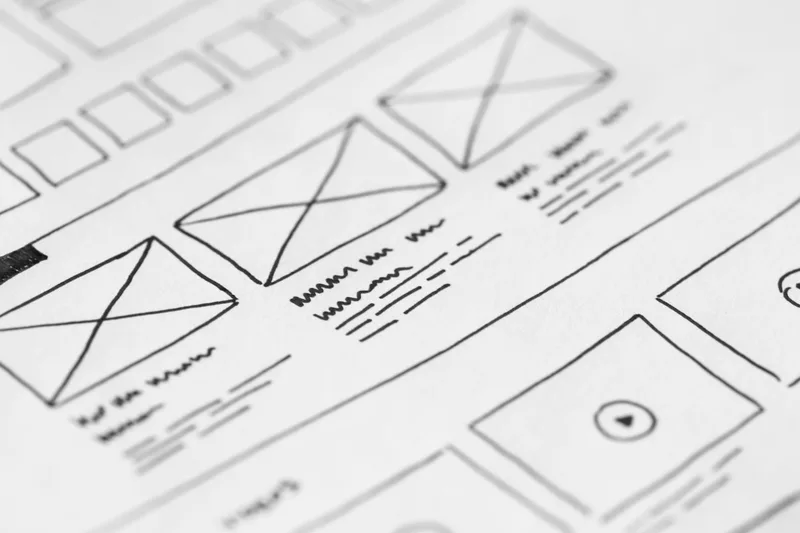
Hand-drawn wireframe sketch representing the section-by-section layout of a landing page template
Walk through what each section is actually doing:
Headline — states the outcome, not the feature. "Cut Your Return Rate in Half" beats "Introducing Our New Sizing Tool."
Sub-headline — kills the objection a skeptical reader has right now. If price is the objection, address value here.
Hero imagery or video — shows the product solving the problem, not sitting on a white background. Flat-lay and lifestyle imagery consistently outperforms studio product shots for landing pages because it shows context.
Proof — reviews, logos, specific numbers. "4.8 stars from 2,000+ customers" beats "Trusted by thousands."
Offer — the actual deal: price, bundle, guarantee, deadline.
CTA — one action, repeated at the top, middle, and bottom of the page. Never two competing CTAs on the same page.
If your current template is missing any of these six, that's the gap to fix before you touch colors or fonts.
You're on the list! We'll be in touch soon.
Want to test ad creative with AI?
Join the waitlist for early access to ConversionStudio.
Which Shopify Apps Offer the Best Landing Page Templates?
You have four real options, and they solve different problems.
Shopify's native Online Store 2.0 sections, PageFly, GemPages, and Shogun cover most landing page template needs. Native sections add zero extra page weight since they're built into your theme. PageFly and GemPages both offer AI-assisted page generation with hundreds of pre-built templates and sections. Shogun is Shopify Plus Certified and doubles as a broader page editor for product and collection pages, not just landing pages.
Native sections win on speed since there's no third-party JavaScript to load. App-based builders win on template variety and features like A/B testing, heatmaps, and funnel building. If your store runs on Online Store 2.0 and your theme has decent section flexibility, start there before paying for an app.
Free vs. Paid Shopify Landing Page Templates: What's the Real Difference?
Free templates are a starting point, not a finished page.
Free Shopify landing page templates give you a layout skeleton but rarely include the testing, personalization, or funnel features that paid tiers unlock. The real cost difference isn't the template itself — most builder apps offer free plans with usable templates — it's what happens after launch. Paid tiers add A/B testing, dynamic personalization by traffic source, and analytics that show exactly where visitors drop off.
A free template and a paid template can look identical on day one. The gap opens after launch, when you need to know why a page converts at 2% instead of 4%. Free tiers usually cap you at a handful of published pages and give you no visibility into visitor behavior beyond basic pageviews. If you're testing one offer on one page, free is enough. If you're running multiple campaigns that each need their own landing page, the paid tier's testing tools pay for themselves the first time they catch a losing headline before you've wasted a week of ad spend.
How Do You Customize a Template Without Killing Its Conversion Rate?
Customization is where most templates get worse, not better.
Customize a Shopify landing page template by changing copy and imagery first, structure second, and never all at once. Swap in your actual product photography, replace placeholder copy with language pulled from real customer reviews or support tickets, and keep the section order intact until you have data suggesting otherwise. Changing five things simultaneously makes it impossible to know which change moved your conversion rate.
Shopper completing an online purchase on a laptop, the final action a landing page template needs to drive
A practical customization order:
Replace every placeholder image with real product photography or lifestyle shots.
Rewrite headline and sub-headline using the exact words customers use in reviews.
Update the proof section with your real review count and rating, not a stock number.
Adjust the offer block to match your actual promotion or guarantee.
Only then, test structural changes — section order, page length, CTA placement — one at a time.
Skipping straight to structural changes before fixing copy and imagery is the most common mistake. A template with generic photos and borrowed language will underperform regardless of how well the sections are ordered.
Handwritten marketing strategy notes with an arrow, representing the planning behind a converting landing page template
When Should You Skip Templates and Build a Custom Landing Page Instead?
Templates cap out the moment your offer stops looking like everyone else's.
Skip templates when your offer needs a non-standard structure — a quiz-based funnel, a comparison-heavy page for a considered purchase, or a bundle builder — that a generic section library can't represent. Templates are built for the median offer. If yours needs to answer objections a template's fixed structure can't accommodate, a custom-built page (or an AI-generated one built specifically around your offer) usually outperforms a heavily-modified template.
This is the gap tools like ConversionStudio are built to close. Instead of starting from a fixed template and hoping it fits, ConversionStudio scans your store's actual market signals, generates an offer suited to what's already converting, and builds the landing page section-by-section around that specific offer rather than a generic skeleton. For a store running one simple promotion, a template is faster to launch. For a store running multiple offers across multiple traffic sources, generating a page around each specific offer tends to outperform retrofitting the same template five different ways.
Puzzle piece against a plain background, representing how template sections need to fit your specific offer to convert
The test is simple: if you've customized a template so heavily that it no longer resembles the original, you weren't saving time. You were building a custom page with extra steps.
Frequently Asked Questions
What is the best Shopify landing page template?
There isn't one universal answer. Shopify's native Online Store 2.0 sections work best for stores wanting zero added page weight. PageFly and GemPages both offer 300+ templates with AI-assisted generation for stores wanting more design flexibility. The right choice depends on your traffic volume, offer complexity, and whether you need built-in A/B testing.
Are free Shopify landing page templates worth using?
Yes, for a single offer or early-stage testing. Free plans from PageFly, GemPages, and Shogun include usable templates, just with fewer published pages and no A/B testing. Once you're running multiple campaigns that each need a dedicated landing page, the paid tier's testing and analytics tools typically justify the cost.
How do I add a landing page template to my Shopify store?
Through the Shopify App Store for third-party builders (PageFly, GemPages, Shogun) or through your theme editor if your theme supports Online Store 2.0 sections. App-based builders add a page via their own editor; native sections are added directly in Shopify's theme customizer under "Add section."
Do landing page templates hurt Shopify page speed?
Third-party builder apps add JavaScript that can slow page load by roughly 0.5-2 seconds compared to native theme sections, depending on how many app features you enable. Native Online Store 2.0 sections add no extra weight since they're part of your existing theme. If page speed is a priority for your traffic source, native sections are the safer default.
Founder of ConversionStudio. 9 years in ecommerce growth and conversion optimization. Building AI tools to help DTC brands find winning ad angles faster.