CLV: What Customer Lifetime Value Is and How to Raise It
September 22, 2026·10 min read·by Faisal Hourani
You're on the list! We'll be in touch soon.
Join the waitlist
Get early access to AI-powered ad creative testing.
What Is CLV?
CLV is what a customer is worth.
Customer lifetime value (CLV) is the net profit a customer contributes over their entire relationship with a business, according to Wikipedia. Shopify's ecommerce version multiplies average order value, purchase frequency and customer lifespan. A customer who spends $50 every six months for four years has a CLV of $400 on that revenue basis.
Wikipedia lists CLV, CLTV, LCV and LTV as names for the same idea. It also notes that CLV sets an upper limit on what you should spend to acquire a customer. It is a forecast, not a report. Customer profitability looks back at what a customer has already earned you. CLV looks forward at what they are likely to earn.
Sources define the number two ways. Shopify's example counts revenue. Others count profit, which means multiplying by gross margin. Use profit when you set a budget, because revenue ignores what the product cost you. Our CLV formula guide covers the margin-adjusted version.
This page is the overview. It explains what CLV tells you, gives you a five-minute way to estimate it, and shows the four levers that raise it. For the full method, see the customer lifetime value formula guide, which covers simple, historical and predictive models.
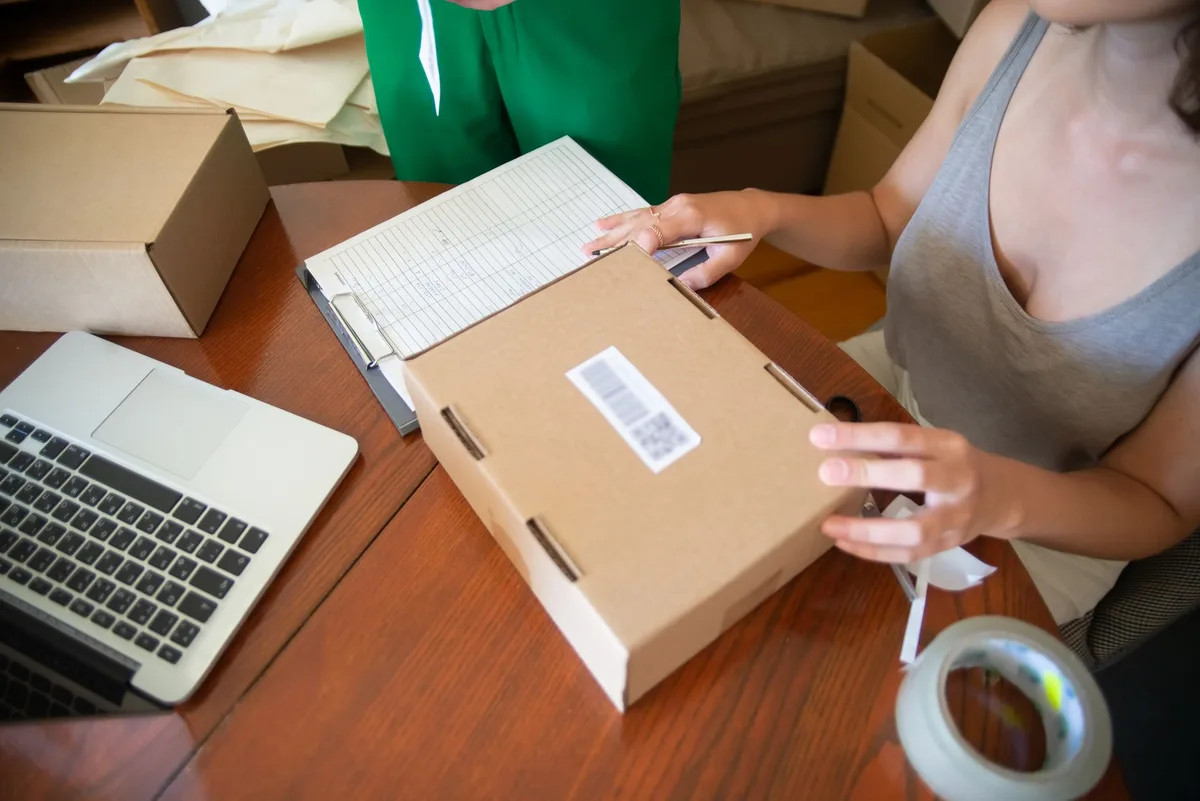
Woman at a wooden table closing a cardboard box with a barcode label, with a clipboard, laptop and roll of tape beside it
Why Does CLV Matter More Than a Single Sale?
One order hides the real picture.
Acquiring a new customer costs anywhere from five to 25 times more than keeping an existing one, depending on the study and industry, according to Harvard Business Review. CLV turns that gap into a budget: it shows how much a customer is worth over time, and therefore how much you can afford to spend to win one.
The same Harvard Business Review article cites research by Frederick Reichheld of Bain & Company. It found that a 5% increase in customer retention raises profits by 25% to 95%. That is one study with a wide range, so treat it as a direction, not a forecast for your store.
Shopify's CLV guide quotes Neil Hoyne, chief strategist at Google, who recommends focusing on CLV over conversion rate. His reasoning: clicks and conversions can bury the customers who come back many times and contribute the most value.
CLV also sets the ceiling for acquisition spend. Shopify's research puts customer acquisition cost (CAC) between $127 and $462 depending on industry, and calls a 3:1 ratio of lifetime value to CAC good. Compare your own CLV with your own CAC before you compare either with those ranges. Our CAC to LTV ratio guide shows how.
How Do You Calculate CLV in Five Minutes?
Start with four numbers you already have.
Multiply average order value by purchase frequency and customer lifespan to get revenue CLV, then multiply by gross margin to get profit CLV. With a $60 order, 2.5 orders a year, a three-year lifespan and a 45% margin, revenue CLV is $450 and profit CLV is $202.50. These numbers are illustrative, not benchmarks.
Input
Where to find it
Example (illustrative)
Average order value
Total revenue divided by number of orders
$60
Purchase frequency
Orders divided by unique customers, per year
2.5 orders
Customer lifespan
Average years a customer keeps buying
3 years
Gross margin
(Revenue minus cost of goods) divided by revenue
45%
Revenue CLV
$60 x 2.5 x 3
$450
Profit CLV
$450 x 0.45
$202.50
Shopify says you can pull the first three inputs from Shopify Analytics or a CRM. Use the same time window for all of them, and a full year of orders if you have it, so one promotion does not skew the average.
Lifespan is the shaky input. With less than a year or two of history, you are estimating it. Wikipedia describes CLV models as ranging from crude heuristics to complex predictive analytics, so treat your first number as a starting point and update it as customer groups age. For segment-level math and category benchmarks, use our CLV calculator guide.
Hand holding a phone with a calculator open above a notebook of handwritten sums, with a laptop showing a price chart behind
You're on the list! We'll be in touch soon.
Want to test ad creative with AI?
Join the waitlist for early access to ConversionStudio.
Which Four Levers Raise CLV?
Each input is a lever.
CLV multiplies its inputs, so a 10% gain in any one of them lifts CLV by 10%. The four levers are average order value, purchase frequency, customer lifespan and gross margin. Choose the lever that costs your store the least to move, then measure it before touching the next.
Here is the same illustrative store, with each input improved by 10% on its own. The starting profit CLV is $202.50.
Lever
What a 10% gain looks like
New profit CLV
Average order value
$60 becomes $66
$222.75
Purchase frequency
2.5 orders becomes 2.75
$222.75
Customer lifespan
3 years becomes 3.3
$222.75
Gross margin
45% becomes 49.5%
$222.75
Every row gains the same $20.25. The math does not rank the levers. Your costs do. A free-shipping threshold is a setting you can change this week. A 10% longer lifespan may need a loyalty program or a rebuilt subscription. Pick by effort and evidence, not by which tactic sounds most exciting.
Is your acquisition cost below your CLV ceiling? Divide your CLV by 3, then check that ceiling against your real CAC with the free CAC calculator. Enter three numbers. Get your answer.
How Do You Raise Average Order Value?
Sell more in the same checkout.
Raise average order value by giving buyers a reason to add one more item: bundles, free-shipping thresholds and post-add-to-cart offers. Shopify's guide describes FactoryPure offering an extended warranty of up to five years in a cart pop-up. Test one change at a time, and watch margin as well as order size.
A higher order value only helps CLV if margin holds. A discount that raises order size 10% while cutting margin 10% leaves profit CLV about flat. That is why the tables above use profit, not revenue.
Free-shipping thresholds. Set the threshold above your current average order value to pull baskets up.
Cart and post-purchase offers. In Shopify's example, a third party handles the warranty process, which makes the warranty an easy way for FactoryPure to raise order value.
Raise purchase frequency by contacting buyers after the first order and removing friction from the next one. Shopify reports that shirt brand Untuckit saw a 33% increase in customer repurchase rate after adopting Shop Pay's accelerated checkout. Reminders, replenishment emails and a wider catalog all give returning customers a reason to come back.
Frequency starts after the first order. The post-purchase experience guide covers the emails and touchpoints that fill the gap between orders.
Product range matters too. Shopify's guide quotes Ridge CEO Sean Frank, who says the brand started with one wallet and "there was no LTV in the business." A small group of superfans bought several, but 99% of people never bought another wallet. Ridge expanded into luggage, rings and phone accessories to give happy customers something else to buy. If your product is a one-time purchase, your frequency lever may be the catalog, not the email flow.
Person opening a cardboard box marked Special Delivery and filled with red shredded paper
How Do You Keep Customers Longer?
Lifespan is where churn shows up.
Lengthen customer lifespan by rewarding commitment and finding out when customers drift away. Shopify's guide reports that subscription brand 123 Baby Box raised CLV by 40% after reworking pricing to reward longer sign-ups, moving average subscription length from five months to eight and cutting churn by 18%. Cohort tracking shows where your own drop-off happens.
123 Baby Box found its problem the way most stores can: it looked at CLV over time and saw "a major drop-off after three months," according to its CEO. Those are the company's own figures for a subscription box, so treat them as an example of the lever, not a target.
To find your own drop-off point, group customers by the month of their first order and track how many come back. Our cohort analysis guide shows how. Loyalty programs are the other common tool. See the best Shopify loyalty program apps.
Two people exchanging blue and pink shopping bags across a glass counter in a boutique
How Do You Raise the Margin Behind CLV?
Revenue is not profit.
Raise margin by cutting the cost of goods, pricing to value and controlling discounts, because every point of margin flows straight into profit CLV. Using the earlier example, moving margin from 45% to 49.5% lifts profit CLV from $202.50 to $222.75 without a single extra order.
Margin gets less attention than the other levers because it lives in your P&L, not your ad account. Check it by product, not just as a blended figure. A blended margin hides the loss-leader bundle that drags a whole channel down. Our cost-plus pricing guide shows how to set prices from your cost of goods.
How Do You Use Your CLV Number?
Turn it into three decisions.
Use CLV to set a ceiling on acquisition spend, to rank customer segments and to spot when retention slips. With a profit CLV of $202.50 and a 3:1 target ratio, the illustrative store can spend up to $67.50 to acquire a customer. Recalculate as cohorts age, because the first estimate is always rough.
Set a ceiling on CAC. Maximum CAC equals CLV divided by your target ratio. Shopify calls 3:1 good, but your own ratio depends on margin and cash flow. The LTV CAC formula guide walks through the ratio.
Rank your segments. Wikipedia describes CLV-based segmentation as a way to find the most profitable customers and what they have in common. Shopify quotes Hoyne on the question to ask: what makes your best customers so special? Split by acquisition channel and first product with a customer LTV analysis.
Watch the trend. Wikipedia notes that retention has a decisive impact on CLV. When CLV falls, check lifespan and frequency first, since both move with retention.
Frequently Asked Questions
What does CLV stand for?
CLV stands for customer lifetime value: the net profit a customer contributes over their entire relationship with a business, according to Wikipedia. It is also written CLTV or LTV. In ecommerce it is usually estimated from average order value, purchase frequency and customer lifespan, then adjusted for gross margin.
What is a good CLV?
There is no universal good CLV, because it depends on your margins and acquisition cost. Shopify calls a 3:1 ratio of LTV to CAC good. If acquiring a customer costs $30, for example, that points to a CLV near $90 or more. Track the trend by cohort rather than judging one snapshot.
Can I calculate CLV with only a few months of data?
Yes, but treat the result as an estimate. Lifespan is the input you cannot measure without history, so a store under a year old is guessing at it. Wikipedia notes CLV models range from crude heuristics to predictive analytics. Start simple, then update the number as each monthly cohort ages.
Does CLV include what I paid to acquire the customer?
No. CLV measures what a customer returns, and CAC measures what it cost to win them, so you compare the two as a ratio. Some teams subtract CAC to get a net figure, so check which version a report uses. Wikipedia's model deducts variable costs, including retention spending, from margin.
clvcustomer lifetime valuewhat is clvhow to increase clvecommerce clv
Share
Written by
Faisal Hourani
Founder of ConversionStudio. 9 years in ecommerce growth and conversion optimization. Building AI tools to help DTC brands find winning ad angles faster.